Our strategy is similar to that of Apple.

Wouter Vermeulen, zaakvoerder van het door zijn ouders opgerichte familiebedrijf Vermeulen, is een man met een plan. Hij leidt de Wetterse kmo met een duidelijk doel voor ogen: de beste en meest complete totaaloplossing bieden, van studie en ontwerp tot nazorg. “Het is een strategie die zware investeringen vraagt, maar op lange termijn wel loont.”
Hier is de vertaling van de volledige tekst naar het Engels, met aandacht voor de zakelijke terminologie en de specifieke vergelijking met Apple.
Thirty Years of Vermeulen
It was 1986 when Peter Vermeulen and his wife, Linda Van Hoecke, officially founded Vermeulen. At the time, Peter had already been working for several years as a self-employed electrical and heating specialist as a secondary occupation. However, with the establishment of the company, they decided to commit to their business full-time. As is the case with many Flemish SMEs, their activities and workforce expanded steadily, and Vermeulen soon positioned itself as a unique player in the high-end residential market.
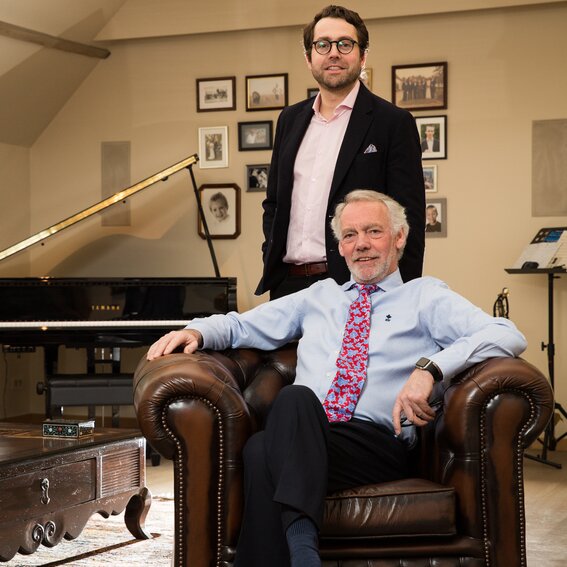
Fast forward to 2021: 36-year-old son Wouter Vermeulen is now at the helm of the East Flemish family business, which still lives up to its name with four Vermeulens on the payroll. "My younger brother and cousin are both technicians, my mother manages the administration, and my father still leads the execution," says Wouter. "I took over the business in January 2021 to ensure continuity: my parents are now both 63 years old, and the average tenure of our staff is 19 years. I might not be one hundred percent technically proficient, but we have that expertise in-house. My strategic vision and approach complement that perfectly."
Wouter has been fully active in the company since September 2020. Before that, he operated from the United States, where he moved about 15 years ago and gained experience in commercial and operational roles at various software technology companies. "At some as an employee, at others as a manager. My strengths lie in the commercial, financial, and human aspects. But I am not a technician; I am not an engineer."
The Higher Market Segment
Wouter is continuing the story started by his father, Peter—albeit with some new areas of focus. That story primarily revolves around total solutions for the higher market segment. "Back in the '90s, we quickly reached a conclusion: we could do hundreds of terraced houses—there’s nothing wrong with that—but we could just as easily do fifteen higher-end villas, where there is more technical diversification and complexity, and a higher level of difficulty."
Today, this 'higher-end clientele' accounts for about 60 to 70 percent of Vermeulen's activities. "We work in Sint-Martens-Latem, Schilde, Waasmunster, Knokke… Client intimacy and trust are very important there, as is the correct installation of complex technologies." From that world, Vermeulen also grew in the B2B segment. "Many people living in those villas are business owners. They see the quality and technical skill of our people in their own homes and ask if we can do the same for their companies. Additionally, we do some B2G (Business-to-Government) work. That requires a completely different approach, but it is also a satisfying business."
The 'Apple Strategy'
For years, Vermeulen has focused on all aspects of electrical engineering, security technology, and sustainable technologies. The company has its own strategy that it has adhered to for years. "You can compare our strategy to Apple's," says Wouter. "From the beginning, that company said: we are going to develop the software, build the hardware, and handle the distribution. That is a strategy that requires very heavy investment to guarantee quality, but it pays off. From day one, we also said: if we want to differentiate ourselves and provide top-tier quality and service, we have to do everything internally. That requires discipline and a strong investment: in the right people, in our own engineering department..."
"Of course, there are many other players who do the same. But what makes us fairly unique is that we also make different technologies talk to each other. That means: regulating, measuring, writing scenarios, integrating, and configuring. That is where the true total solution lies."
The HVAC World
A total solution that connects all building technologies naturally includes ventilation and climate control. And that is exactly where the problem often lies, according to Wouter. "HVAC contractors have a very different DNA from ours. They are now entering a world where they are sometimes intimidated by smart boilers and technologies. Of course, there are those who are fully on board and doing a great job, but an electrician simply has a head start because we have been working on the configuration and integration of technologies for 10 to 15 years."
Currently, Vermeulen often works with HVAC installers as subcontractors. "There are many installers who say: we still want to work with our hands, but the configuration and technologies are for you. That’s fine with us, but last year we asked ourselves why we should maintain that way of working. We are selling more and more total solutions, and in every project, electricity and HVAC come together anyway. If we cannot calculate and design both aspects of building technology from the start, we aren't making the right move. An acquisition of an HVAC company will therefore certainly be on the agenda. Because organic growth is a long-term process."
Personnel
This brings us to a well-known sensitive subject in this sector: personnel. Wouter has what he calls a nuanced view on the matter. "I often hear companies say they can't find staff. Well, we receive about fifty CVs per month. About five people per week come in for an interview. We start one or two of those people, and we retain about half of them. The problem is: with this method, we only see success with 'juniors.' Vermeulen is a training company where we have been 'molding' talent for thirty years. We have partnerships with schools and universities, we offer internships, we use recruitment agencies… But to manage our growth properly, we also need experienced electricians and project engineers. And that, in my opinion, is the bottleneck: that 'middle layer'."
The labor market has also changed significantly in recent years, Wouter believes. "Half of the people we have hired in the past ten years are electromechanics graduates who came from a general education background. They have little practical experience, but we need them for the configuration and integration of building technologies. That is completely different compared to the past. The rougher, heavier work has shifted entirely to foreign labor. And it must be said: the quality of their work is sometimes lower. That’s when the 'race to the bottom' begins. Because of our activities in the higher segment, we are fortunate enough to attract interest from people with higher degrees more easily, but you have to invest in talent. That is where I think many companies go wrong—they work with margins that are too small, forcing them to limit personnel costs. We are content with remaining a slightly smaller company but having more left over at the end of the day. I know that’s easier in our segment, but it’s a double-edged sword: expectations are also much higher. The quality of our work and our service must be top-notch."
Evolutions in the Sector
Both father and son have seen the world of electricity change significantly. "One of the biggest evolutions in recent years has taken place in building technologies," says Wouter. "Automation has played a major role in this. As a result, it has become increasingly important to have all technologies communicate with each other. The wiring in the wall remains the foundation, of course. But because more and more devices are becoming 'smart,' manufacturers must work to a certain standard so those technologies can all speak to each other. This is a massive evolution that benefits the peace of mind of the end customer, but it sometimes makes things harder for the installer who only 'delivers and places' and has never participated in the study and design phase. As mentioned, this is a major challenge, especially in the HVAC world. Those who do not adapt to these smarter technologies will be left behind."
"Furthermore, I believe this communication between technologies will make systems more sustainable. I think we are still a few years away from energy management solutions that offer 100% efficiency and where everything is perfectly aligned, but we are heading in that direction. Currently, the sector isn't ready, and neither is the end user. They might buy a smart thermostat that also controls the air conditioning, but they don't have other smart appliances yet. But that is coming faster than we think."
Original article published by Professional Media Group (January 19, 2021).
Related